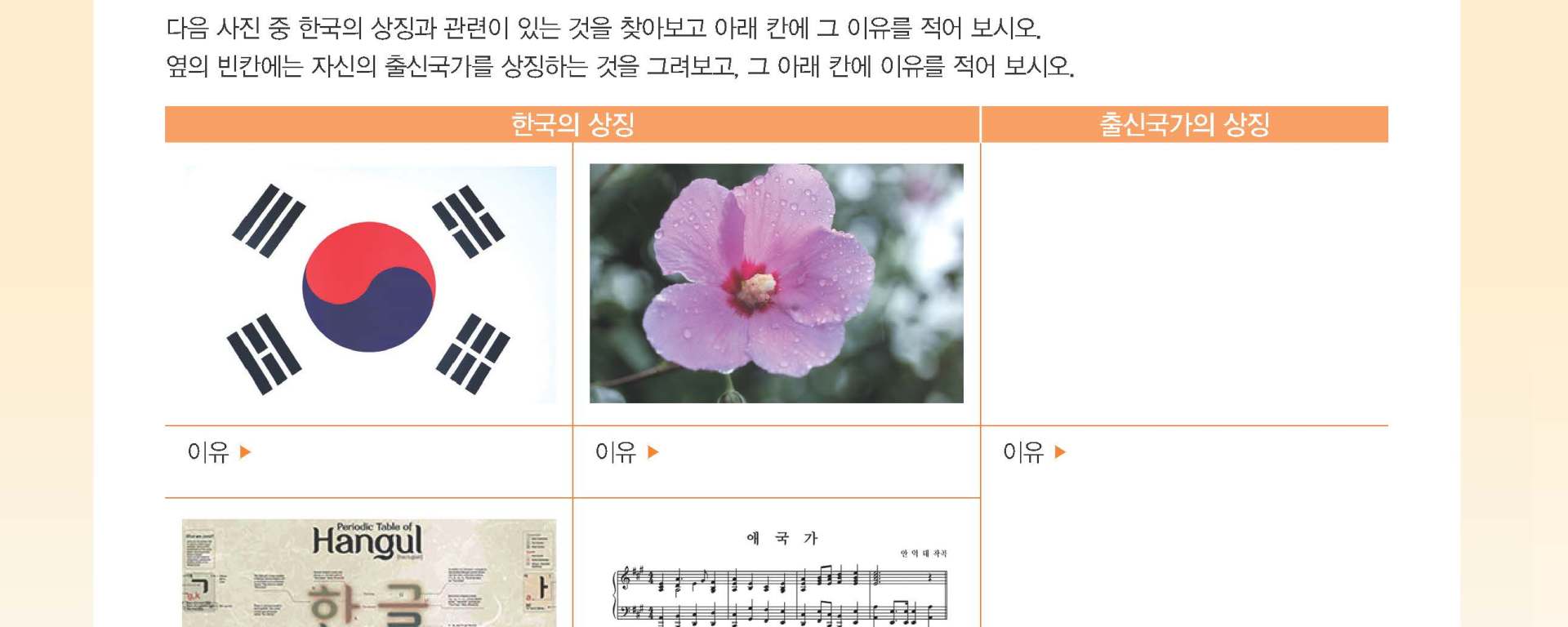
옆의 빈칸에는 자신의 출신국가를 상징하는 것을 그려보고, 그 아래 칸에 이유를 적어 보시오 (In the space next to you, draw a symbol of your country of origin and write the reason in the space below it.)
학습목표 보기 View Learning Objectives
1. 한국의 정식 국가명이 ‘대한민국’임을 말할 수 있다.It can be said that Korea’s official name is ‘Korea’.
2. 대한민국을 상징하는 국가, 국기, 국화에 대해 말할 수 있다.We can talk about the nation, the national flag, and the chrysanthemum that symbolizes the Republic of Korea.
3. 대한민국의 문자인 한글이 어떻게 만들어졌는지에 대해 말할 수 있다.We can talk about how Hangeul, the Korean alphabet, was created.
Section 1-대한민국의 국기와 국가는?What is the national flag and country of Korea?
한국의 정식 국가명은 대한민국이다.The official name of Korea is the Republic of Korea.
한국은 대한민국이라는 국가명을 줄여서부르는 것이다. Korea is short for the name of the Republic of Korea.
한자로는 大韓民國, 영어로는 The Republic of Korea라고 한다.In Chinese characters, it is called the Republic of Korea and in English, The Republic of Korea.
일반적으로 남한이나 South Korea라고 하는 경우도 있는데, 이것은 북한과구별하여 부르는 명칭이다.In general, there are cases called South Korea or South Korea, which is called separately from North Korea.
현재의 국가명인 대한민국은 1948년부터 사용되고 있다.The current name, the Republic of Korea, has been in use since 1948.
대한민국의 국기를 태극기(太極旗)라고 부른다.The national flag of the Republic of Korea is called the Taegeukgi.
태극기는 흰색 바탕에 빨강과 파랑의 태극 문양이중앙에 있고, 모서리에 검은색의 4괘가 있다.The Taegeukgi has a red and blue taegeuk mark on a white background, and a black four trigrams at the corner.
흰색 바탕은 밝음과 순수, 평화에 대한 사랑을의미한다.The white background means brightness, purity, and love for peace.
중앙에 있는 태극 문양 중 빨강은 존귀,파랑은 희망을 나타내고, 빨강과 파랑이 합쳐진것은 조화로운 우주를 표현한다. Among the Taegeuk patterns in the center, red represents honor and blue represents hope, and red and blue combine to represent a harmonious universe.
태극 문양의주변에 있는 4괘는 각각 하늘(건), 땅(곤), 물(감), 불(리)을 의미하는 것으로자연의 조화를 강조한다. The four trigrams around the Taegeuk mark mean heaven (gun), earth (gon), water (gam), and fire (ri), respectively, emphasizing harmony between nature.
이러한 의미를 고려할 때 태극기는 평화와 화합을강조하고 있음을 알 수 있다. Considering this meaning, we can see that Taegeukgi is strengthening peace and harmony.
한국에서는 국경일이나 국가기념일에 태극기를자신의 집 문가나 창가에 다는 것이 일반적이다.In Korea, it is common to hang the national flag by the door of one’s house or window on national holidays or national holidays.
나라마다 그 나라를 상징하는 노래인 국가가 있다. Each country has its own national anthem, a song that symbolizes that country.
대한민국에서는 국가를 애국가라고 하는데, ‘나라를 사랑하는 마음을 담은 노래’라는 의미를 가지고 있다. In Korea, the national anthem is called the national anthem, which means ‘a song with a love for the country’.
약 100여년 전부터 사용되어 온 애국가는 전체 4절로 구성되어 있는데, 중요한 국가 행사를제외하고는 대체로 1절만 부르는 경우가 많다. The national anthem, which has been used for about 100 years, consists of four verses, and is often sung only in the first verse, except for important national events.
알아두기 Note
애국가 National anthem
1절 : 동해물과 백두산이 마르고 닳도록 하느님이 보우하사 우리나라 만세 Section 1 : and Baekdusan Mountain are dry and worn away, God, protect and preserve the day when our nation.
2절 : 남산 위에 저 소나무 철갑을 두른 듯 바람서리 불변함은 우리 기상일세 It’s our weather to see the wind frosting like a pine wrapper on top of Namsan Mountain Namsan.
3절 : 가을 하늘 공활한데 높고 구름 없이 밝은 달은 우리 가슴 일편단심일세 The high, cloudless, bright moon in the autumn sky is the single heart of our hearts.
4절 : 이 기상과 이 맘으로 충성을 다하여 괴로우나 즐거우나 나라 사랑하세 This spirit and this heart are devoted to your suffering and joy, but I love you.
후렴(각 절마다) : 무궁화 삼천리 화려강산 대한사람 대한으로 길이 보전하세 Chorus (for each temple): Mugunghwa Samcheon-ri, Hwantanggangsan, Daehan-do, and the road to preserve it.
Section 2 대 한민국의 국화와 문자는? What are the chrysanthemums and texts of the Greater Korea?
대한민국을 상징하는 나라의 꽃은 무궁화이다. Mugunghwa is the flower of the country that symbolizes the Republic of Korea.
무궁화라는 명칭에는 ‘영원히 피고 또 피어서 지지않는 꽃’이라는 의미가 담겨 있다. The name Mugunghwa means “a flower that blooms forever and never loses.”
실제로 무궁화는보통 7월에서 10월 사이에 매일 꽃을 피우면서나무 하나에 약 2천여 개의 꽃송이가 핀다. In fact, Mugunghwa usually flowers every day between July and October, with about 2,000 flowers blooming per tree.
한국에서 무궁화는 오래전부터 나라를 상징하는 꽃으로사랑받아 왔다. In Korea, Mugunghwa has long been loved as a symbol of the country.
또한 현재는 다섯 잎의 무궁화꽃이 활짝 핀 모양을 활용하여 대한민국 정부를상징하는 대한민국 국가 문장으로도 활용되고 있다.It is also used as a national sentence to represent the Korean government by utilizing the blooming shape of the five-leaf Mugunghwa flowers.
한글은 지금으로부터 약 600여 년 전에 조선의 세종대왕이 창제하였다. Hangeul was invented about 600 years ago by King Sejong of the Joseon Dynasty.
한글은 자음(14개)과 모음(10개)을 결합하여 하나의 글자를 이룬다는 점에서 과학적인문자라는 평가를 받고 있다. Hangeul is considered a scientific alphabet in that it combines 14 consonants and 10 vowels to form a single character.
자음은 사람의 발음기관을 보고 만들었고, 모음은 하늘(·), 땅(-), 사람(ㅣ)이라는 세 가지 요소를 결합하여 만들었다. The consonants were made by looking at human phonetic organs, and the vowels were made by combining three elements: heaven (·), earth (-), and man (ᅵ).
자음과모음을 합하여 모두 24개이며, 소리 나는 대로 적으면되기 때문에 배우기가 비교적 쉽다. There are 24 consonants and vowels in total, and it is relatively easy to learn because you can write down as it sounds.
일반 백성도 쉽게배울 수 있는 한글이 만들어진 이후에 문맹이 줄어들었고 이는 한국의 문화를 발전시키는 데 큰 도움이되었다. After the creation of Hangeul, which can be easily learned by ordinary people, illiteracy decreased, which greatly helped develop Korean culture.
이와 같은 한글의 성과를 기념하기 위해유네스코(UNESCO)에서는 세계적으로 문맹 퇴치사업에 많은 기여를 한 사람이나 단체를 선정하여 상을 주는데 그 상의 이름을 ‘세종대왕상’이라고 정하였다 In order to commemorate the achievements of Hangeul, UNESCO named the statue the “King Sejong Award” for selecting and awarding people or organizations that have contributed a lot to the world’s efforts to eradicate illiteracy.
한국에서 태극기를 다는 날 Taegeukgi Day in Korea
3월 1일 (삼일절) : 일제의 지배에 저항하여 1919년에 일으킨 독립만세 운동을 기념하는 날 March 1st (Samiljeol) : A day to commemorate the independence movement that was launched in 1919 against Japanese rule.
6월 6일 (현충일) : 국가를 위해 자신의 목숨을 바친 순국선열을 기념하는 날 (조기 게양) June 6 (Day of Memorial): Day to commemorate the patriotic martyrs who sacrificed their lives for the nation (early hoisting)
7월 17일 (제헌절) : 1948년 대한민국 최초의 헌법이 제정된 날을 기념한 날 July 17 (Constitution Day): The Day of the First Constitution of the Republic of Korea was enacted in 1948.
8월 15일 (광복절) : 1945년 일본의 지배에서 벗어나 독립을 맞이한 것을 기념하는 날 August 15 (Gwangbokjeol) : Day to commemorate the liberation from Japanese rule in 1945
10월 3일 (개천절) : 한반도에 최초의 국가가 만들어진 것을 기념하는 날 October 3 (National Foundation Day): Day to commemorate the creation of the first nation on the Korean Peninsula
10월 9일 (한글날) : 세종대왕이 한글을 만든 것을 기념한 날 Oct. 9 (Hangul Day): The day King Sejong celebrated the creation of Hangeul.
 Expat In Korea